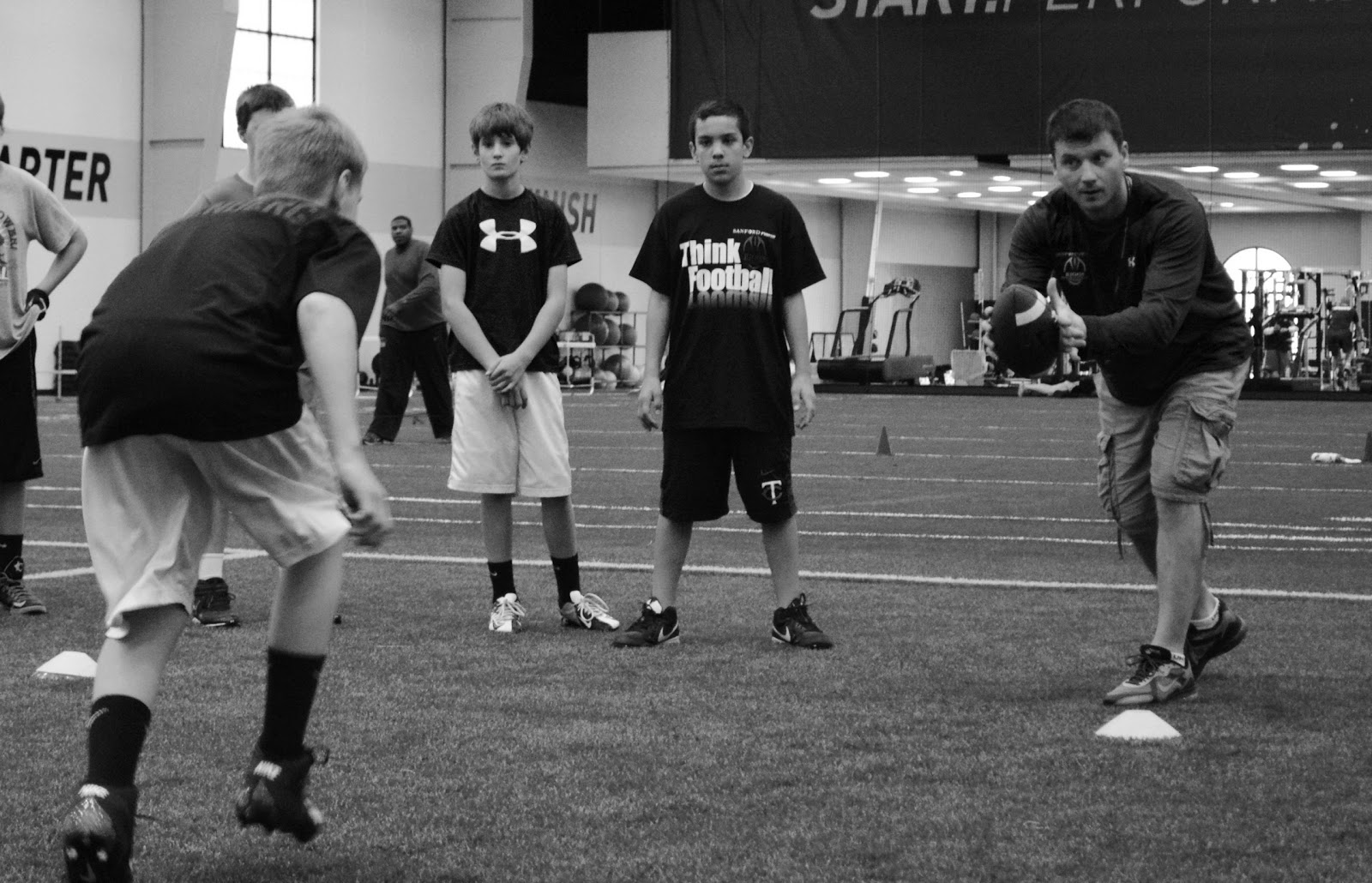
**This column appeared in the Argus Leader on Dec. 21, 2015.
You will be hearing a great deal about safety in the sport of football with the Christmas release of the movie, “Concussion.”
The movie centers around still-developing scientific research regarding the long-term effects of concussions on football players. Hopefully this will prompt families to engage in discussions about safety in all of youth sports.
Many families will see this movie and wonder if they should let their child play football at all. Obviously, football has been a huge part of my own life, so I am strongly in favor of letting kids play the game. That being said, I also support the ongoing research and efforts to improve player safety and minimize the risks of injury.
Parents have always wrestled with the decision of whether or not to let their kids play football, hockey and other contact sports. If they let their kids play, what age would be the best to begin? Should they have their child play flag football instead of tackle football? What helmet should their child wear? Is the coach teaching correct tackling form? Are the league and officials doing their best to protect kids? Concussions are very serious, and we continue to strive to create a safer game, but are concussions the only safety factor that we need to consider? Should the risk of injury prevent kids from participating in football at all?
Research tells us there are risks to playing football. Science has come a long way in measuring the effects of concussions on athletes in all contact sports. As a result, the sport is evolving to improve fundamentals and training for athletes. While it is impossible to eliminate the risk of injury for athletes in contact sports, there are things we can do to help minimize the risk and still expose our kids to the many benefits of youth sports.
Ultimately, parents need to decide what is acceptable for their athlete. How does a parent do this? Be informed about the risks, and ask questions of the coaches and directors of youth programs.
● Is my child being trained using the newest, safest standards for the sport?
● What kind of training have coaches received on player safety? Is correct tackling technique being worked on every day?
● What is the team protocol if my child is injured during practice or a game?
● What is the coaching philosophy for working with young athletes?
● Is the coach organized and using drills that are incorporated within the structure of practice, or is the coach using hard-hitting drills to waste practice time?
● Are the athletes excited and moving around, rather than standing and listening to someone lecture the entire practice?
● Are all facets of the game being taught in the limited practices? Not just practicing plays, but teaching tackling, blocking, alignment, special teams, etc.
● Is the team atmosphere healthy and focused on learning while having fun?
● Is your athlete physically able to keep up with his/her teammates?
● Is your athlete mentally and physically ready for the things which he/she will be asked to do?
In football, it is critical for kids to learn proper fundamentals for tackling. It is extremely important that their learning coincides with their physical development. This is why many kids start with flag football and progress into tackle football as they develop strength and technique. Adjusting to the use of equipment is necessary and encouraged with young athletes, but all contact should be controlled and limited by coaches until they are confident in the athlete’s skills and comfort level.
Parents can not rush physical development by forcing an athlete into a sport they are not ready to play. The athlete’s lack of ability will be shown physically and mentally, and that is when the risk of injury increases. Flag football allows the athlete to grow and mature, while at the same time becoming confident and mentally prepared to eventually take that next step into tackle football. Communication and trust between parents and coaches is critical to this process.
While much of the conversation from the movie will center on the risk of injury in contact sports, don’t lose sight of other important points of consideration. We all want our kids to experience the many physical and mental benefits of being part of youth sports, and with proper training and support, kids can be involved in football but minimize the risk of serious long-term injury. Be informed about the science and the sport, ask questions about the programs you are considering for your athlete, and ultimately, make the decisions that are the best fit for your family.
I am often asked my opinion on things that involve football. The questions range from how to find which player position best suits a child to who I think will win the Super Bowl, and pretty much everything in between. I have many thoughts on the game, on coaching, and on improving performance, so I am starting Passing Thoughts to share some of those thoughts. I welcome your comments and conversation. –KR
Showing posts with label concussion awareness. Show all posts
Saturday, January 30, 2016
Sunday, May 31, 2015
Flag or Tackle? Making the Choice
As a long time coach, parents often ask me questions about their child’s development. One of those recurring questions is whether or not a child is ready to move from flag football to tackle football. The safety of the sport has grabbed a lot of headlines lately, so I understand concerned parents who are hesitant to make the move from flag to tackle or are reluctant to try football at all. There are advantages to playing at both levels, and it is important that families make the decision with good background information.
1. There is no risk of being tackled, having to block, or encountering extremely physical play. Athletes can work their basic skill development on every play and have more opportunities catching and throwing the ball.
2. The flag environment is very controlled with tighter rules and coaches on the field.
3. Athletes establish confidence in game fundamentals and on-field skills that can carry over to tackle football.
4. Flag is the best place to begin the process of Heads Up Football training. There is no substitute for learning proper fundamentals!
5. Athletes can easily transfer the fundamentals they learn in practice onto the game field. Kids can run plays and routes, and practice concepts that are more difficult to reinforce in youth tackle football.
What are the advantages to tackle football?
1. Playing tackle football is a great team sport where teammates rely on each other during every single play.
2. OLine and DLine players have an opportunity to work fundamentals and succeed at the positions suited for them.
3. In a positive environment with good coaching, young athletes can establish confidence that carries over to things on and off the field.
4. Transitioning through established programs promotes proper skill development. SDJRFB does an excellent job helping develop young athletes to successfully transition into middle school and high school football.
5. There has been tremendous effort through Heads Up Football to improve the safety of tackle football and increase concussion awareness for youth players. Learning proper fundamentals is proving to be key to improving safety for kids.
Most young athletes will play flag football in their early years in the sport, and at some point, they will look at transitioning to tackle. When parents ask me if their child is ready, these are the things I ask them:
1. Does your child ever physically shy away from contact on the field?
2. When you see a group of athletes participating in an event, do you feel that your child is at all behind the other kids in coordination, motor development, or processing the movements needed to compete?
3. Do you think your child needs continued focus on game fundamentals and skill development?
If you answered any of these with "yes," then you should consider staying with flag.
There are definite advantages to both flag and tackle, depending on the skill level of the athlete and the comfort level of his/her parents. Be sure to talk to your coaches and get informed opinions about what is best for your child! It isn’t just a question of age and equipment, it is a question of development and readiness, so consult with people who are familiar with your child’s abilities. We will see a lot of elementary-aged athletes this summer at the Fieldhouse, so don’t hesitate to ask our staff if you have questions about your child’s readiness for flag or tackle.
Whether parents choose flag or tackle, they should know their child will be gaining valuable skills that will have lasting benefits on and off the field. Have fun, and enjoy the game!
Thursday, June 27, 2013
Heads Up with Sanford's National Institute for Athletic Health and Performance
One of the prime motivators behind Heads Up Football is increasing knowledge about the long term effects of concussions. The NFL has invested in research on player injuries, and its partnership with USA Football has led to additional investment and planning to promote a "better, safer game" for youth leagues. Both organizations are publishing their concussion studies, and we asked Thayne Munce, PhD, Associate Director of Sanford's National Institute for Athletic Health and Performance to weigh in on USA Football's recently published results. These are Dr. Munce's thoughts on the issue:
Many aspects of football that make it such a popular sport also put its players at an inherent risk for injury. Recently, there has been a lot of attention and concern about the risk and consequences of concussion and mild traumatic brain injury in football. While mainstream media has largely focused on the NFL and its high-profile players, the discussion on main street USA has turned to concerns about youth football.
Some of the questions being asked are:
How dangerous is football for kids?
How old should kids be before playing football?
Should kids be playing football at all?
While its natural for people to panic in response to scary headlines and nobody should ever fault parents for wanting to protect their children, it’s important for people’s decisions, ultimately, to be guided by scientific evidence. Unfortunately, we have many more questions than answers at this point, as the science on this topic is still in the very early stages.
How dangerous is football for kids?
How old should kids be before playing football?
Should kids be playing football at all?
While its natural for people to panic in response to scary headlines and nobody should ever fault parents for wanting to protect their children, it’s important for people’s decisions, ultimately, to be guided by scientific evidence. Unfortunately, we have many more questions than answers at this point, as the science on this topic is still in the very early stages.
Football’s national governing body, USA Football, recently released preliminary findings from a study it commissioned on youth football health and safety. The results are from Year one of a two year study examining injuries in youth football players (6-14 years old). Approximately 2,000 players from youth leagues in six states are being monitored by the Datalys Center for Sports Injury Research and Prevention. After the first year of data collection, which comprised nearly 60,000 sessions (practices & games), it was found that 3.6% of the players sustained one or more concussions. Overall, 9.7% of the players experienced an injury that restricted their participation to some extent. Injuries were more likely to be sustained in games than practices. Fortunately, no catastrophic head, neck or heat-related injuries occurred during the season.
Around 70% of all football players in the US are younger than high school age, and surprisingly, there is very little information about concussion rates and risk among this population. The USA Football study is the largest of its kind among youth football players, making its findings very important. Furthermore, Datalys, the group commissioned to perform this study, also oversees the NCAA injury surveillance program, giving further credibility to this research.
While the preliminary findings of this study are limited, there are still some important observations that can be made.
First, the concussion rate of 3.6% is consistent with another recently published study of nearly 500 youth football players that reported a concussion rate of 4.3%. On a per player basis, these concussion rates for youth are relatively low compared to previous reports among high school players that have been as high as 20%. However, more recent findings have placed the percentage of high school football players who suffer at least one concussion during a season at 5.6%, which is much closer to the rate reported for youth.
Considering that youth football seasons are typically shorter and have fewer sessions (both games and practices) than high school football, the youth concussion rate may actually be higher than the high school rate on a per session basis, depending on what study is used. We’ll learn more next year when the study is complete. Finally, it’s important to note that many concussions, particularly among boys, go unreported. Without knowing the exact methods by which concussions were reported/diagnosed in the USA Football study, it’s likely that the actual number of concussions sustained in this group was actually higher than 3.6%.
USA Football estimates that approximately 2.8 million youth (under high school age) play tackle football. If the 3.6% concussion rate is extrapolated across the entire youth football landscape, that works out to be just over 100,000 concussions per year. Yet again, the actual number is probably higher than that due to underreporting and players who sustain more than one concussion during a season. Clearly, 100,000 or more concussions a year in youth football is a big number, and worthy of the attention this injury is receiving in the scientific and medical communities. Furthermore, it’s understandable why players and their parents are concerned about this serious health and safety issue. In order to keep football as safe as possible, coaches, league administrators and medical personnel need to have a better understanding of the risk of concussion in football so that it can be appropriately managed. This USA Football study, when completed, will be an important piece of that puzzle.
Around 70% of all football players in the US are younger than high school age, and surprisingly, there is very little information about concussion rates and risk among this population. The USA Football study is the largest of its kind among youth football players, making its findings very important. Furthermore, Datalys, the group commissioned to perform this study, also oversees the NCAA injury surveillance program, giving further credibility to this research.
While the preliminary findings of this study are limited, there are still some important observations that can be made.
First, the concussion rate of 3.6% is consistent with another recently published study of nearly 500 youth football players that reported a concussion rate of 4.3%. On a per player basis, these concussion rates for youth are relatively low compared to previous reports among high school players that have been as high as 20%. However, more recent findings have placed the percentage of high school football players who suffer at least one concussion during a season at 5.6%, which is much closer to the rate reported for youth.
Considering that youth football seasons are typically shorter and have fewer sessions (both games and practices) than high school football, the youth concussion rate may actually be higher than the high school rate on a per session basis, depending on what study is used. We’ll learn more next year when the study is complete. Finally, it’s important to note that many concussions, particularly among boys, go unreported. Without knowing the exact methods by which concussions were reported/diagnosed in the USA Football study, it’s likely that the actual number of concussions sustained in this group was actually higher than 3.6%.
USA Football estimates that approximately 2.8 million youth (under high school age) play tackle football. If the 3.6% concussion rate is extrapolated across the entire youth football landscape, that works out to be just over 100,000 concussions per year. Yet again, the actual number is probably higher than that due to underreporting and players who sustain more than one concussion during a season. Clearly, 100,000 or more concussions a year in youth football is a big number, and worthy of the attention this injury is receiving in the scientific and medical communities. Furthermore, it’s understandable why players and their parents are concerned about this serious health and safety issue. In order to keep football as safe as possible, coaches, league administrators and medical personnel need to have a better understanding of the risk of concussion in football so that it can be appropriately managed. This USA Football study, when completed, will be an important piece of that puzzle.
At Sanford Health, we have been working to advance health and safety in youth football in a variety of ways. In 2011, Sanford played a key role in championing concussion legislation that was passed in SD, ND and MN. We have worked with SD Junior Football for many years by providing the league and its coaches with educational information in wellness sessions and printed literature. More recently, we have engaged SD Junior Football in a series of studies investigating neurological function and head impact exposure in youth football players. These studies, being performed right here in Sioux Falls, are the first of their kind among youth football players in the entire nation! Some of this work has already been presented at national sports medicine meetings, and we hope to publish our complete findings later this year. Sanford Research has generously supported these important studies, and we look forward to making meaningful contributions in the future that will help improve the health and safety of youth football players, both locally and throughout the nation.
Finally, as a heads up, we are preparing for an exciting new concussion awareness campaign with a partner that people in the upper Midwest are sure to recognize. I can’t reveal any details at this time, but I can assure you that we’ll have some big shoulders to help us carry the message.
If you have any questions about youth football health and safety research, feel free to contact me at:
Thayne Munce
National Institute for Athletic Health & Performance
Sanford Health
thayne.munce@sanfordhealth.org (605) 328-4756
We are fortunate to be in a community where this kind of research is valued and ongoing. As SDJRFB progresses into HUF, we believe that young athletes in Sioux Falls will be on the leading edge of these important improvements to change the football culture to emphasize safety. There are big changes coming for our athletes, and we are excited to be part of that change. Next up in our blog series, we will be talking with Kevin Kaesviharn about his NFL career and his thoughts on HUF for SD athletes. Don't miss it!
Finally, as a heads up, we are preparing for an exciting new concussion awareness campaign with a partner that people in the upper Midwest are sure to recognize. I can’t reveal any details at this time, but I can assure you that we’ll have some big shoulders to help us carry the message.
If you have any questions about youth football health and safety research, feel free to contact me at:
Thayne Munce
National Institute for Athletic Health & Performance
Sanford Health
thayne.munce@sanfordhealth.org (605) 328-4756
We are fortunate to be in a community where this kind of research is valued and ongoing. As SDJRFB progresses into HUF, we believe that young athletes in Sioux Falls will be on the leading edge of these important improvements to change the football culture to emphasize safety. There are big changes coming for our athletes, and we are excited to be part of that change. Next up in our blog series, we will be talking with Kevin Kaesviharn about his NFL career and his thoughts on HUF for SD athletes. Don't miss it!
Sunday, April 14, 2013
Heads Up: Coaching for Change
American Football Monthly recently ran an article entitled Safety First--Culture Shift: Changing the culture of football to reduce violent injuries. You can read it here. It is an excellent and timely reminder about the improved safety efforts being made at the highest levels of the sport. We are seeing a shift in football culture to be more about preventing injuries than just treating them. Whether we are parents, coaches, fans, or athletes, we all bear responsibility to do what we can to reduce the risk of serious injuries to our players.
Changing the culture of football requires change at every level. As a result, the NFL has partnered with USA Football to place extra emphasis on the importance of teaching fundamentals to young athletes and concussion awareness to coaches through their Heads Up Football Program. USA Football is training coaches nationwide how to teach kids proper tackling technique and fundamentals, and they are working with the NFL to ensure that kids see and recognize those proper techniques and fundamentals when they watch their favorite NFL athletes. It is a comprehensive plan to emphasize proper form and safer play at every level of the sport, starting with our youngest athletes. They released this tackling video last fall to demonstrate the Heads Up Tackling technique:
The coaches at Riggs Premier Football stand solidly behind the efforts of Heads Up Football. The tackling techniques are intuitive and well explained, and kids learn fundamentals that will make them better overall players and reduce their risk of serious head injuries. Our coaching staff discussed what we could do to help promote changing the culture of football in our region, and we came up with several responses:
1) Coach Siegfried and I went through the certification process with USA Football to ensure that Riggs Premier Football’s instruction is in line with USA Football’s recommendations;
2) We are partnering with SD Junior Football to offer their summer camps, and for the first time in program history, the camps will be full pads. That will give our coaches the opportunity to do focused training for young athletes in proper tackling technique and fundamentals;
3) We are assisting SD Junior Football with their culture change of requiring all coaches to be USA Football certified. I, and several of my staff, will serve as Player Safety Coaches for the region and assist in training and certifying Junior Football coaches;
4) We launched our Think Football program with a full series of camps, clinics, and tournaments for athletes of all ages during Summer, 2013. Through this range of offerings, athletes can learn and develop proper fundamentals at every position, participate in a focused tackling clinic, or participate in camp or tournament style settings which promote safe play along with the competitive atmosphere. With Think Football, we are focused on athletic development, mental aspects of the game, and gaining understanding of how to improve individual and team performance. No matter which events athletes choose from this program, they are guaranteed careful emphasis on fundamentals and technique. We believe that is an essential component of teaching the sport to promote the changing culture.
NFL Commissioner Roger Goodell has been speaking around the country about the efforts to develop a safer game for players. In a speech to the University of North Carolina last month Goodell said, “There is a national conversation taking place about football. We welcome it. That’s how we approach our jobs every day: Looking at changes to the game not as something to be feared, but as something we need to do as if the future of the game relies on it. Because it does. The risk of injury in football is well known, but throughout history, football has evolved and become safer and better.”
Changing the culture of football requires change at every level. As a result, the NFL has partnered with USA Football to place extra emphasis on the importance of teaching fundamentals to young athletes and concussion awareness to coaches through their Heads Up Football Program. USA Football is training coaches nationwide how to teach kids proper tackling technique and fundamentals, and they are working with the NFL to ensure that kids see and recognize those proper techniques and fundamentals when they watch their favorite NFL athletes. It is a comprehensive plan to emphasize proper form and safer play at every level of the sport, starting with our youngest athletes. They released this tackling video last fall to demonstrate the Heads Up Tackling technique:
The coaches at Riggs Premier Football stand solidly behind the efforts of Heads Up Football. The tackling techniques are intuitive and well explained, and kids learn fundamentals that will make them better overall players and reduce their risk of serious head injuries. Our coaching staff discussed what we could do to help promote changing the culture of football in our region, and we came up with several responses:
1) Coach Siegfried and I went through the certification process with USA Football to ensure that Riggs Premier Football’s instruction is in line with USA Football’s recommendations;
2) We are partnering with SD Junior Football to offer their summer camps, and for the first time in program history, the camps will be full pads. That will give our coaches the opportunity to do focused training for young athletes in proper tackling technique and fundamentals;
3) We are assisting SD Junior Football with their culture change of requiring all coaches to be USA Football certified. I, and several of my staff, will serve as Player Safety Coaches for the region and assist in training and certifying Junior Football coaches;
4) We launched our Think Football program with a full series of camps, clinics, and tournaments for athletes of all ages during Summer, 2013. Through this range of offerings, athletes can learn and develop proper fundamentals at every position, participate in a focused tackling clinic, or participate in camp or tournament style settings which promote safe play along with the competitive atmosphere. With Think Football, we are focused on athletic development, mental aspects of the game, and gaining understanding of how to improve individual and team performance. No matter which events athletes choose from this program, they are guaranteed careful emphasis on fundamentals and technique. We believe that is an essential component of teaching the sport to promote the changing culture.
NFL Commissioner Roger Goodell has been speaking around the country about the efforts to develop a safer game for players. In a speech to the University of North Carolina last month Goodell said, “There is a national conversation taking place about football. We welcome it. That’s how we approach our jobs every day: Looking at changes to the game not as something to be feared, but as something we need to do as if the future of the game relies on it. Because it does. The risk of injury in football is well known, but throughout history, football has evolved and become safer and better.”
I agree with Commissioner Goodell that there is no way to completely eliminate the risks of injury in such a physical sport, but improving player knowledge and increasing concussion awareness will help reduce the risks without being detrimental to the sport. Riggs Premier Football is proud to be part of that changing culture in South Dakota.
Subscribe to:
Posts (Atom)